
What Is Swing in Drum Programming? The Secret Behind Groove

Updated: Jul 22

You're staring at a perfectly programmed hi-hat pattern – every step exactly where it should be – and it sounds lifeless.
Technically correct.
Totally dead.
That's not a programming problem. It's a swing problem.
The Core Idea
Swing is simple in concept: it shifts the timing of certain notes to create groove.
Instead of every hit landing at perfectly even intervals, swing delays certain notes – most commonly the off-beats.
That small shift is the difference between a loop that sits still and one that moves.
Straight vs Swing: What's Actually Happening
With straight timing, your hi-hats land exactly evenly:
1 & 2 & 3 & 4 & 1/8th note exampleEvery off-beat falls precisely between the beats. It’s tight, predictable, and – if you’re not careful – robotic.
With swing, those off-beats get nudged slightly later:
1 … & 2 … & 1/8th note exampleThe gap before the off-beat gets bigger. The gap after it gets smaller. That uneven spacing is what your body responds to. That's the head-nod. That's groove.
Swing Amount: The Numbers That Matter
Swing is usually expressed as a percentage.
Those percentages tell a story.
Amount | Feel |
50% | Straight – no swing at all |
55–60% | Subtle groove, adds bounce |
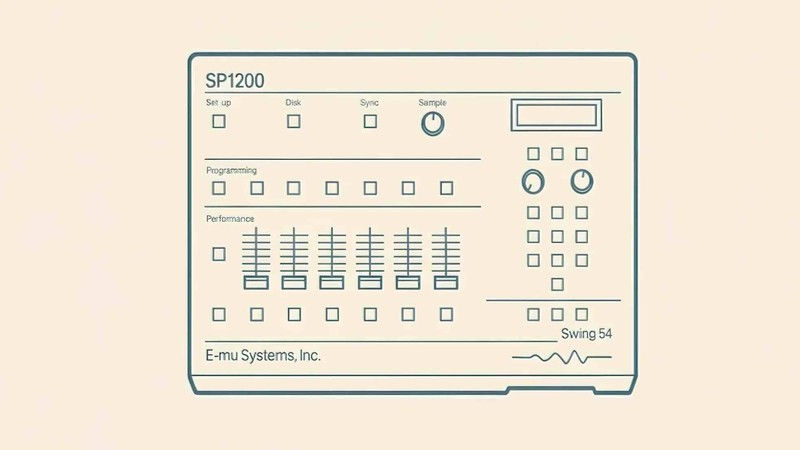
65–70% | Heavy swing – hip-hop, MPC feel |
75%+ | Shuffle – very lopsided, almost triplet |
Even a 2–3% change is audible.
Where You Hear It
House / UK Garage – subtle swing, enough to give the groove a bounce without losing the drive
Hip-hop / Boom bap – heavier swing is part of the DNA, that classic MPC sound
Jazz / Shuffle – extreme swing pushed all the way toward a triplet feel
In many genres, it's part of the identity.
That's why House feels different to Hip Hop.
Detroit Techno feels different to UK Garage.
Part of that identity comes from the swing.
Not every groove comes from swing.
Dynamics, note placement and phrasing all contribute too.
Swing is simply one of the most common ways of creating feel.
A Better Mental Model
Swing changes the relationship between beats.
You're not nudging a note slightly late.
You're stretching one gap and shrinking the next.
That uneven spacing is what creates forward motion.
The music leans into the next beat rather than falling onto it.
Hear It for Yourself
The visualiser above lets you see and hear exactly what's happening in a 16th note example.
Hit play with swing at 50% – that's your straight grid, everything mechanical and even.
Now drag the slider up toward 65% and watch the off-beats (the e and a steps) shift right in real time while the main beats stay locked.
The gaps between notes stop being equal.
One gets longer, one gets shorter. That's the head-nod.
Try the genre zones as you drag: somewhere around 54–57% you'll start to feel a house bounce creep in. Push it to 65% and you're in MPC territory.
Hit 70%+ and it tips into shuffle, that almost-triplet feel you hear in jazz and old soul records.
Then do this: get it sitting somewhere that feels good – say 60% – and snap it back to 50%.
You'll feel it flatten.
That's how much difference a few percent can make.
Swing is one of those things that sounds like a technical detail, but it's at the centre of what makes you feel the music.
Get familiar with it – not just as a percentage you adjust, but as something you're shaping deliberately every time you build a groove.


Comments