
Why Reference Tracks Matter in Mixing: How to Use Them for Better Translation

Updated: Jul 22

When you mix the same style of music every day, reference tracks can feel optional. If you know your room, your monitors, and your gear inside out, you can trust your decisions. Engineers like Chris Lord-Alge can sit down, move faders, and know exactly how their mix will translate everywhere.
But most of us aren’t mixing under those conditions. And most modern producers are jumping between genres, aesthetics, and sonics far more than we’d like to admit. That’s where reference tracks become one of the simplest–and most effective–tools in the room.
When You Can Get Away Without References
If you’re consistently mixing:
The same style of music
On a monitoring chain you know extremely well
In a room you trust
…then your internal “translation curve” becomes accurate enough that you don’t need to check anything else. Your judgement becomes the reference.
But for everyone else? It’s worth having backup.
Why Reference Tracks Become Essential
Most real-world producers and mixers deal with variables:
Unfamiliar genres
A room that isn’t perfectly treated
Monitors that have blind spots
Headphones that exaggerate or hide certain frequencies
That’s when references stop being a luxury and start becoming a navigation tool.
They anchor your judgement, especially when your environment can’t fully be trusted.
Your Monitoring Chain Still Matters
Reference tracks don’t replace good monitoring–they support it.
Useful monitoring checks include:
Good studio monitors
Headphones (open-back and closed-back perspectives)
Mono speaker (for midrange and balance)
Room correction – physical treatment and plugin-based systems
All of these give you different angles on your mix. But reference tracks give you context.
Choosing the Right Reference Tracks
This is where the real work is.
Think of reference tracks as a personal library of “known quantities.” These should be tracks you’ve heard:
On Bluetooth speakers
In cars
On club systems
In headphones
In your studio
If a track sounds great somewhere, it’s a candidate for your ref pile for that playback environment.
Club track hits differently? Add it.
Bluetooth speaker bass surprises you? Add it.
A mix collapses on earbuds? Study why.
Collect them deliberately.
Using ADPTR Metric AB for Fast Comparison
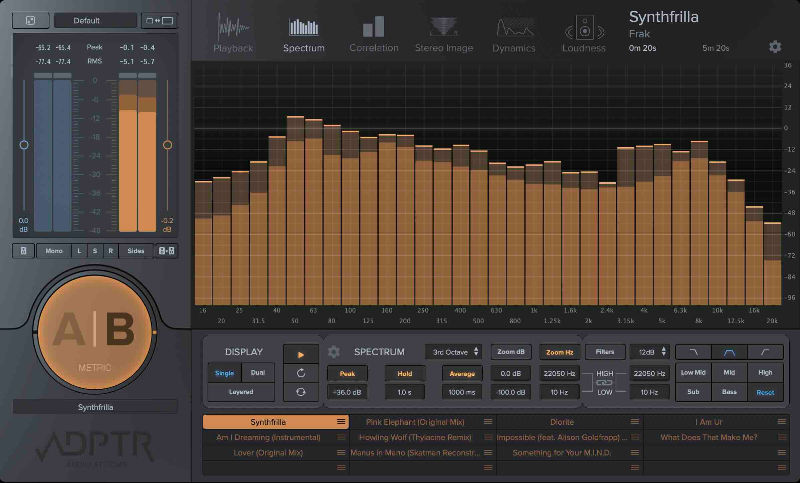
My go-to tool is Metric AB by ADPTR Audio.
I can load multiple references for different reasons:
Low-end weight
Stereo width
Brightness
Vocal placement
Overall loudness feel
Switching between them is instant. No guesswork, no workflow interruption.
Mini-Mixes: Getting Inside the Frequency Bands
Metric AB has one killer feature:
You can solo frequency bands within each reference track.
This lets you make what Mike Dean calls mini mixes:
The low-end mix
The midrange mix
The air-band mix
It’s the same concept as checking Mid vs Side while mixing–you’re examining the internal balance that makes the final mix work.
These micro-perspectives help you understand:
How loud the subs actually are
How bright the top end really sits
How dense the mids should feel
Then you bring those insights back into your own mix.
Reference Tracks Aren’t Cheating
Some people still treat reference tracks like training wheels.
They’re not.
They’re a compass–nothing more, nothing less. They help you move confidently toward the mix you think you’re making.
If you trust your references, and you understand why you chose them, they’ll guide you all the way to the finish line.


Comments